Synthetix AI
Market Ops Engine
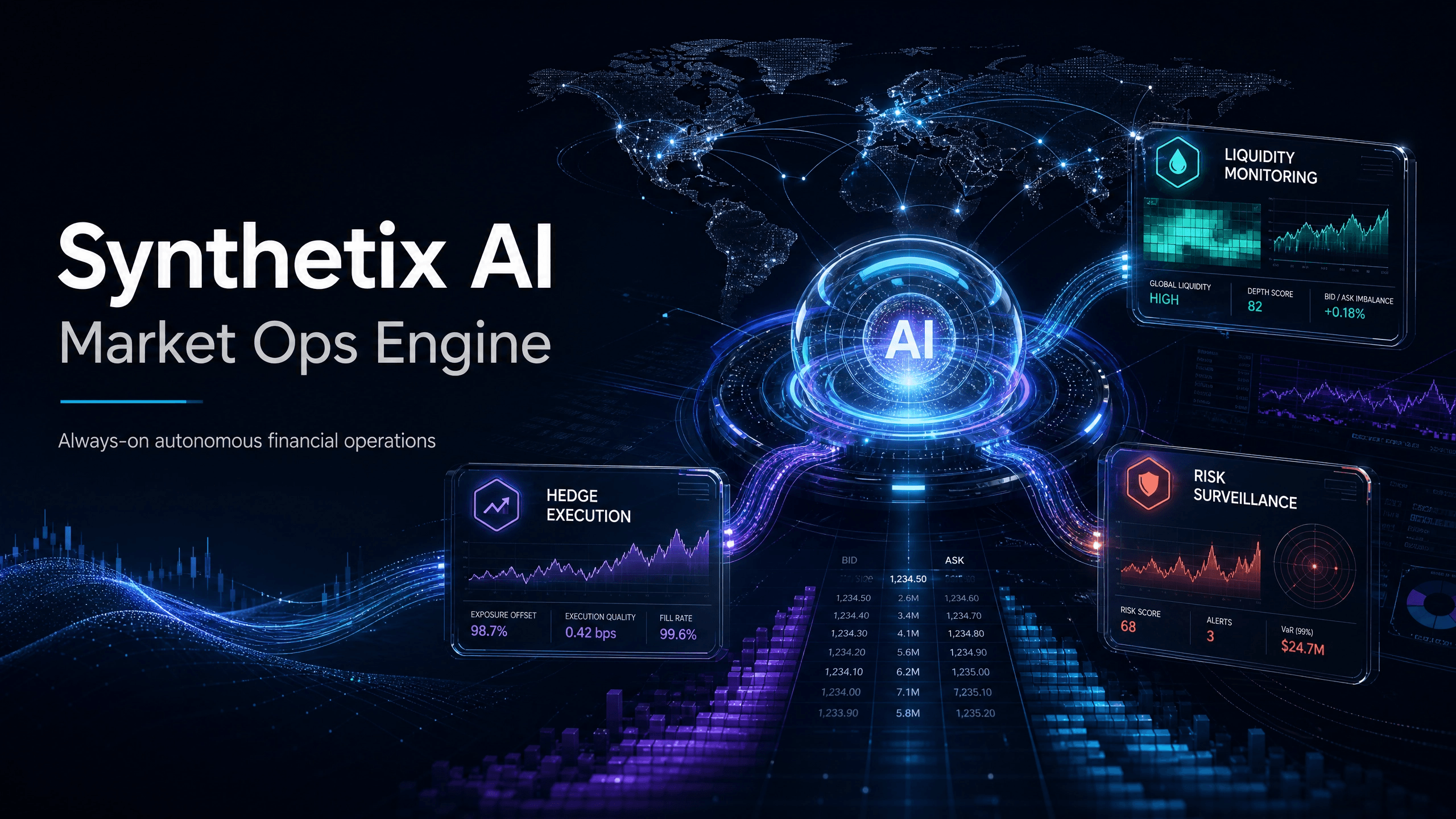
A multi-agent financial operations platform that replaced a team of analysts with an always-on autonomous system — monitoring liquidity, executing hedges, and flagging risk in real time.
The problem: analysts drowning in data
Synthetix ran a 24/7 crypto derivatives desk. Their team of six analysts manually watched liquidity pools across 14 exchanges — tabbing between dashboards, copy-pasting numbers into spreadsheets, and firing Slack messages when something looked off.
The bottleneck wasn't talent. It was speed. By the time a human spotted an arbitrage window or a liquidity imbalance, the window had closed. They needed a system that never blinked.
"We were paying six people to do a job a machine could do faster, 24 hours a day, without missing a single event."
— Head of Trading, SynthetixWhat we built
We designed and shipped a four-agent pipeline: a Watcher agent polling exchange APIs every 50ms, a Risk Engine running portfolio delta calculations in real time, a Hedge Executor that autonomously triggered positions when thresholds were breached, and a Report Synthesiser summarising overnight market behaviour into a 6am briefing.
The frontend — built in Next.js — gave the trading team a single glass pane: live position maps, agent status, and the ability to override any autonomous action with a single click.
Architecture & data contracts
Mapped 14 exchange WebSocket APIs. Designed the agent message bus and PostgreSQL schema for tick-level event logging.
Watcher & Risk Engine agents
Built the first two agents. Latency target hit at 94ms median. Stress-tested against 60-day replay of historical tick data.
Hedge Executor + Claude integration
Wired Claude API as the reasoning layer for ambiguous hedging decisions. Human-approval workflow built for positions above threshold.
Frontend & handoff
Next.js dashboard, agent health monitors, alert log, override controls. Full team training and documentation handoff.
Impact after 30 days live
Within the first month, the Ops Engine processed over 4.2 million market events, triggered 1,847 autonomous hedges, and produced zero missed-window incidents that their previous manual process would have caught.